29 October 2026 · 8 min read
Who owns the capacity AI frees up?
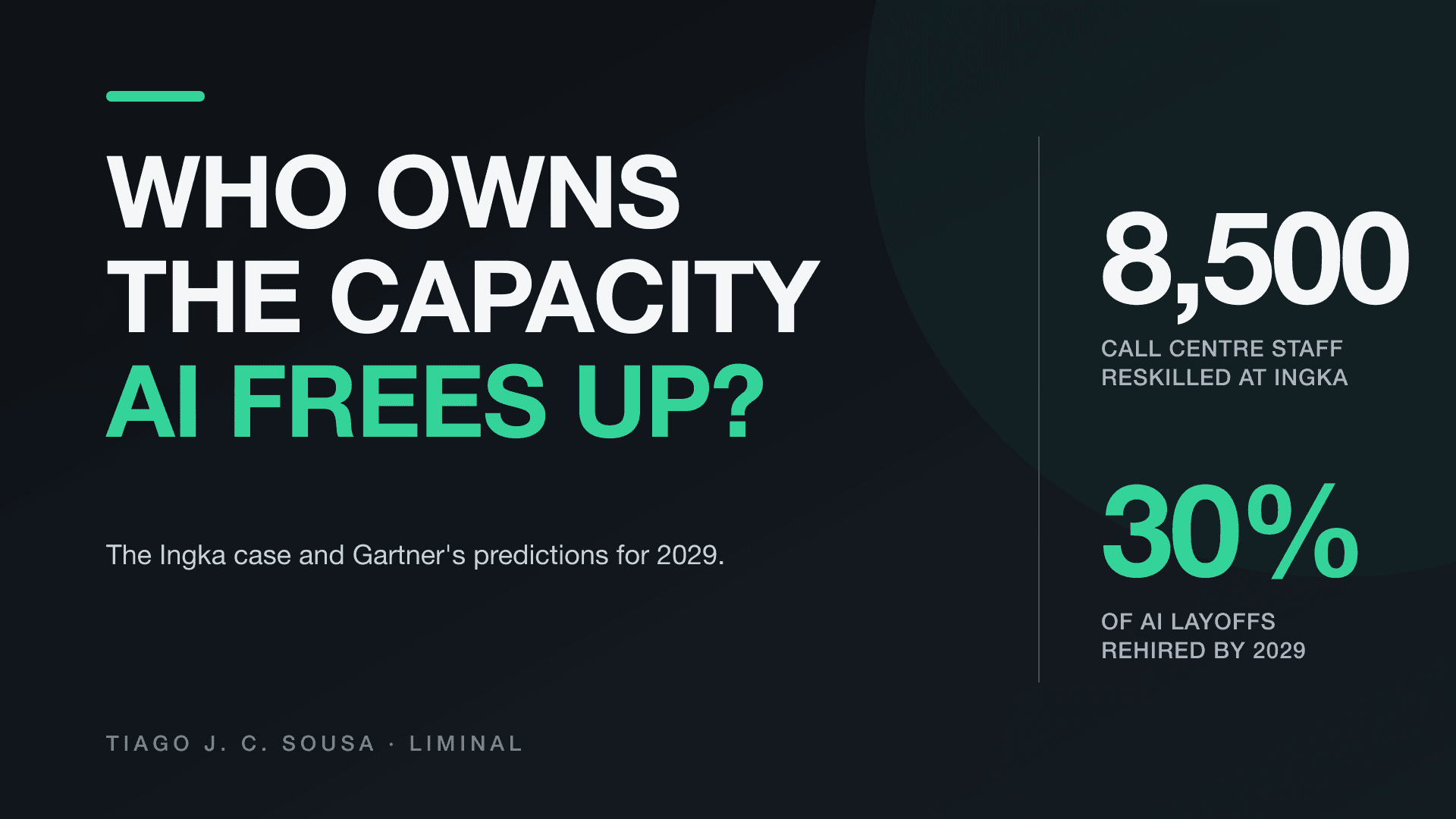
What Gartner has just predicted for cuts made in the name of AI, what Ingka did in 2021 with the hours a chatbot gave back to its team, and the metric missing from almost every business case.
In 2021, Ingka Group, IKEA's largest franchisee, put an AI assistant in front of its customers. It called it Billie, after the Billy bookcase. Two years later, Billie was handling 47% of the queries reaching its call centres.
The next step seemed obvious: shrink the call centre teams and book the difference as a saving in the annual report.
Ingka took a different route. It trained 8,500 call centre staff as interior design advisers, working remotely by phone or video. In the 2022 financial year, that channel sold €1.3 billion, 3.3% of group sales, and the target became reaching 10% by 2028.
In June 2023, Reuters asked Ulrika Biesert, Ingka's global people and culture manager, whether more AI would mean fewer people. The answer was short: "That's not what we're seeing right now."
The hours Billie gave back to the team had a defined destination, with revenue attached, before anyone could book them as a saving. That is exactly the decision missing from most AI business cases.
The question dominating the boardroom
Almost every discussion about AI in customer service starts with the same question: how many people can the technology replace? That question produces the metric that tracks the project, the containment rate, meaning the share of conversations the bot resolves without a human. It also produces the business case line, converted into full-time equivalents and then into euros.
The arithmetic is right, but incomplete. What AI gives back to the company are hours from people who know the product, the customer and the operation, and who are no longer tied up with the most repetitive question of the day. Those hours are an asset. When nobody is accountable for them, they almost always end up booked as a cut, because that is the only line in the business case anyone knows how to fill in.
Gartner put numbers on this risk in September 2026, in the release accompanying its Hype Cycle for the Future of Work. Tori Paulman, VP Analyst, summed it up: "When business and IT executives look back on the early AI-era, they will realize their greatest mistake was believing that work automation was the point, when workforce amplification was the opportunity."
The chart accompanying the release helps explain the moment. Generative AI and conversational user interfaces, the technologies behind almost every customer service chatbot, are already in the Trough of Disillusionment, and AI agents are sliding down from the peak. For Gartner, the challenge for executives now lies in using AI to amplify human intelligence, expertise and creativity.
Hype Cycle for the Future of Work, 2026. Source: Gartner (September 2026).
30%
Of employees laid off due to replacement by AI will need to be rehired by 2029, often at higher cost (Gartner)
75%
Of organizations treating AI gains as cost savings will be eclipsed by 2027 by those that reinvest them (Gartner)
The second prediction is the harder one for anyone signing off budgets. It puts a deadline, 2027, on the decision to treat productivity gains as savings instead of reinvesting them in innovation, modernization and upskilling. Paulman warns of reductions "too deep and too soon" and proposes an alternative Gartner calls a talent remix: using AI to reshape roles and redirect workers from less productive work to new opportunities.
The Ingka case, with the right numbers
The Ingka story has been circulating on LinkedIn for months, almost always with the numbers rounded up. It's worth going back to the source, because the accurate version is more useful to anyone who has to decide.
The €1.3 billion figure, which on social media often appears as $1.4 billion in "extra" revenue, is the total sales of the remote design channel in the 2022 financial year. There is no public data on how much of that revenue is incremental, or on its margin. The 47% measures the share of call centre queries Billie handled over two years. And Ulrika Biesert's answer on cuts referred to the moment it was given, "right now", with no commitment for the future.
With the right numbers, the case gets more interesting. Ingka made a human capital allocation decision: it took the hours automation had freed up and pointed them at a service with its own revenue, built on an asset it already had, people who knew the catalogue and spoke to customers every day.
47%
Of call centre queries handled by Billie over two years
8,500
Call centre staff trained as interior design advisers since 2021
3.3%
Of Ingka's FY2022 sales came from the remote design channel. Target: 10% by 2028
Where hyperpersonalization comes in
There's a reading of this case that most commentary misses: AI and people ended up with different kinds of conversation.
Billie took the standardized conversations, the ones with a right answer that repeat thousands of times a day. People took the ones that depend on the specific customer: this room, these measurements, this budget, this family. In practice, that is what hyperpersonalization looks like. Technology handles at scale what is the same for everyone, and people handle, one by one, what changes from customer to customer.
For anyone leading marketing, sales or customer experience, there's a direct consequence. A hyperpersonalization project needs people with time for the conversations technology can't have. AI in customer service can be the source of that time, as long as someone gives it a destination before it lands in the cost-reduction plan.
The objections worth answering
"IKEA sells furniture to consumers. In a B2B or mid-sized company, there's no interior design service waiting to happen." The objection is fair, and what carries over from the case is the mechanism: identifying the highest-value conversation that goes unhad today because the team is busy with the lowest-value one. In B2B, that conversation almost always exists: onboarding new customers, account expansion, pre-sales technical advice, renewing contracts at risk.
"Call centre agents aren't designers. Mass reskilling lowers quality." The criticism is fair, and professional interior designers have made it on LinkedIn. Ingka's service answers a different need, that of the customer alone in a showroom trying to work out whether the sofa fits the living room. For that customer, product knowledge and practice talking to people count for more than academic design training. The rule to take from this is simple: freed hours should go where the skills the team already has create an advantage.
"IKEA itself is closing call centres." Also true. In February 2026, IKEA announced the closure of its customer support centre in Rostock, Germany, affecting 279 jobs. The reasons given are structural, the expiring lease and the investment the site would need, and none of the sources mention AI. The episode shows that reskilling is a decision made case by case, even within the same brand. Freed capacity only has an owner when someone names one, every time.
Market data suggests that decision is still open in most companies. A Gartner survey of customer service leaders, published in December 2025, found that only 20% report AI-driven headcount reduction. The capacity is being freed up regardless, and the decision about where it goes is still to be made.
What to bring to the next business case discussion
- Separate freed capacity from savings. An AI business case in customer service should present freed hours as a line of its own, before converting them into cost reduction. When the cut is the only option on the table, the decision was made before the meeting.
- Measure where the hours go, as well as containment. The containment rate shows how much work left people's hands. A second metric, the revenue or retention generated by redirected hours, shows what those people went on to do, and changes the conversation at board level.
- Name an owner before automating. Someone has to be accountable for deciding which higher-value conversation gets the hours AI gives back. Without that owner, the hours dissolve into invisible work or end up in the next cost-reduction plan.
The question that remains
AI will free up capacity in almost every company, whether boards plan for it or not. Cutting is the fastest way to show its value in a quarterly report, and also the easiest move for competitors to copy, because any company can lay people off.
So the most useful question to bring to the board is this: which customer conversation goes unhad today because nobody has time for it? The answer shows where freed capacity should go, and it almost always points to the next revenue line.
Sources
- Gartner. (2026, September 9). Gartner Identifies 4 Shifts Shaping the Future of Work [Press release]. Republished by CXOToday.
- Gartner. (2026). Hype Cycle for the Future of Work, 2026.
- Gartner. (2025, December 2). Gartner Survey Finds Only 20% of Customer Service Leaders Report AI-Driven Headcount Reduction [Press release].
- Reuters. (2023, June 13). IKEA bets on remote interior design as AI changes sales strategy. Republished by RTÉ and The Star.
- Eurofound. (2026). Ikea, Rostock [Restructuring event, announced 25 February 2026].
- Nordkurier. (2026, June 4). Ikea schließt Callcenter und der Sozialplan: Verdi spricht von Billigversion.