
From Zero to Hyper-Personalisation
Marketing, CRM and Automation Strategies with Artificial Intelligence in the MarTech Era
Get the first chapter5
Parts
17
Chapters
264
Pages
A manual on what to do on Monday morning, with cases, mistakes and numbers from real companies.
The argument
In a market where technology redefines marketing every quarter, the question is no longer which tool to buy. It has become in what order to build.
This book walks through that order: organizing data, centralizing the customer in the CRM, automating what deserves to be automated, and only then applying artificial intelligence to anticipate behavior and personalize at scale. From attraction to loyalty, from segmentation to hyperpersonalization.
It is not a book about the future of marketing. It is a manual on what to do on Monday morning, with cases, mistakes and numbers from real companies.
Who it's for
- Marketing professionals who want to move on from improvisation and build a system.
- Business owners and managers who approved a technology budget and haven't seen a return yet.
- Students and professionals transitioning into MarTech roles.
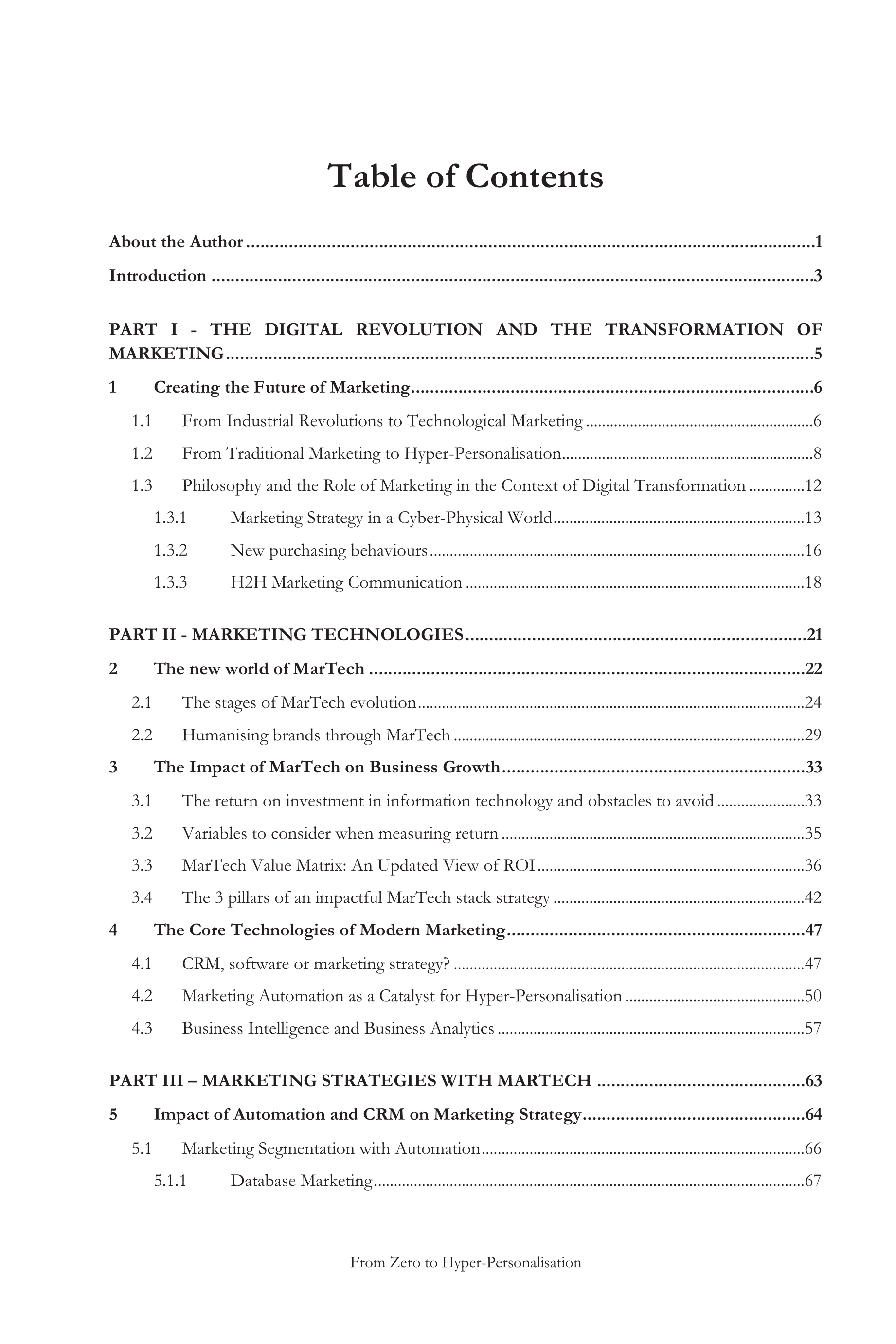
Table of contents
Part I — Digital Revolution and the Transformation of Marketing
- 1. Creating the Future of Marketing
Part II — Marketing Technologies
- 2. The New World of MarTech
- 3. The Impact of MarTech on Business Growth
- 4. The Core Technologies of Modern Marketing
Part III — Marketing Strategies with MarTech
- 5. The Impact of Automation and CRM on Marketing Strategy
- 6. Customer Journey and Relationship Marketing Automation
- 7. Automated Customer Lifecycle Management
- 8. Content Marketing and Marketing Automation Strategy
- 9. Business Analytics and Marketing and Sales Effectiveness
Part IV — Implementing CRM and Automation
- 10. Roadmap for CRM Implementation
- 11. Roadmap for Marketing Automation Implementation
- 12. Teams and Competencies
- 13. IT Systems
Part V — Hyperpersonalization with Automation and Artificial Intelligence
- 14. Marketing Automation Maturity Curve
- 15. Advanced Marketing Automation
- 16. Artificial Intelligence in Marketing
- 17. The End of Traditional Automation and CRM
The first chapter, free.
Leave your email and receive the opening chapter as a PDF, plus access to the newsletter.
Requesting the chapter also subscribes you to the "Tiago J. C. Sousa, Insights" newsletter. Your data is also copied to Liminal MarTech's CRM, so you may also receive commercial communications from Liminal MarTech.
Buy
Available on Amazon, in paperback and Kindle. £13.09
The purchase is made directly on Amazon, and is subject to Amazon's own terms, delivery times and returns policy.

Collective work
ISBN 978-989-5819-35-5
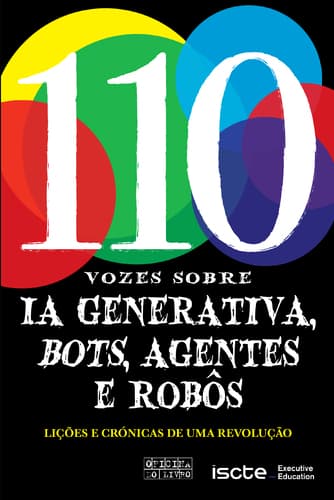
110 Voices on Generative AI, Bots, Agents and Robots
Lessons and Chronicles of a Revolution
110 Vozes sobre IA Generativa, Bots, Agentes e Robôs
Tiago J. C. Sousa is one of the 110 voices invited to think about artificial intelligence from several angles: work, learning, ethics, productivity, citizenship, employability, inclusion, risk, decision and the future.
The book brings together leaders from some of the largest companies operating in Portugal, published under the ISCTE imprint. It is published in Portuguese only, so the title above is a translation.
Among the 110 voices
Ana Figueiredo
CEO and Chairman of MEO
Ricardo Martinho
President of IBM Portugal
Andres Ortolá
General Manager of Microsoft Portugal
Sofia Marta
Country Manager of Google Cloud in Portugal
Nuno Parreira
General Manager of Samsung Portugal
Rita Mendes Coelho
Country Manager of Visa Portugal
Hélder Dias Ribeiro
Chief Digital & Technology Officer at Sonae MC
Sandra Costa
Global GenAI Skilling & Adoption Lead at EDP
Sara Candeias
Chief Data Officer at Banco Montepio
Pedro Gomes Mota
Director of Data & AI at Grupo Brisa
Diana Grilo Silva
Head of Interactions at Critical TechWorks
Pedro Santa Clara
Professor and Entrepreneur
Chapter by Tiago J. C. Sousa
AI First? The human myopia no algorithm can correct
“It is not AI that fails. It is the strategic vision of those who implement it. A vision that starts from the assumption that the human is a cost to eliminate, rather than the centre of the value to create.”