4 August 2026 · 4 min read
56% decide by gut instinct, and call it "data-driven"!
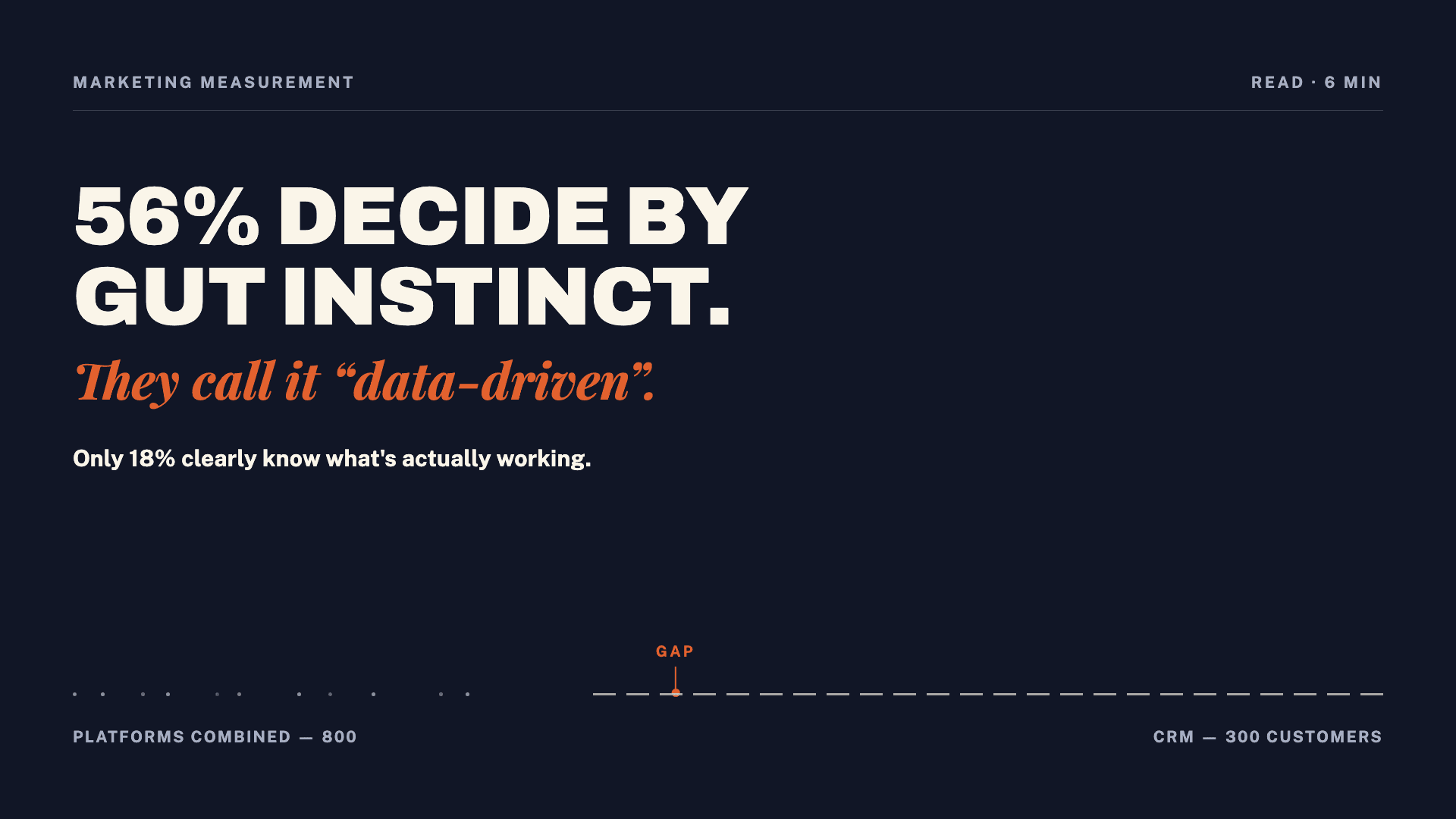
Your team runs six tools to measure performance. And 56% of marketers still decide by gut instinct.
More instrumentation didn't buy more certainty. It bought more dashboards to disagree with each other.
More instrumentation didn't buy more certainty. It bought more dashboards to disagree with each other.
Bitly's new Marketing Visibility Report got read this week as one more alarm about a lack of data. It's the opposite. The problem isn't scarcity. It's excess nobody has reconciled.
What the numbers say, read together
The numbers say it all.
18%
Clearly know what's actually working
19%
Use marketing attribution tools
6
Tools, on average, to piece the data together
5 days
On average, before acting on a new insight
The average team runs six tools to piece performance together, and a third run seven or more. Only 19% use attribution tools. And between receiving an insight and acting on it, five days pass on average.
Notice what these figures describe. This isn't a blind team. It's a team drowning in signals nobody reconciles.
Let me show you what that looks like in practice.
Thursday, before the board meeting
A marketing director opens three tabs to build a slide.
Google Ads reports 400 conversions for the quarter. Meta claims another 220. LinkedIn adds 180. Each dashboard is authoritative. Each one is "data." Add them up: 800.
Then she opens the CRM. New customers for the quarter: 300.
Nothing is broken. Each platform counted honestly, by its own rules, and then claimed credit for the same buyers. The gap between 800 and 300 isn't an error to fix by Monday. It's three confident stories asking her to pick one. And no number, in any tool, tells her which.
It's the pattern Igor Flyunt described publicly: platform-reported conversions that, added together, exceed the customers the company actually won.
The cost nobody accounts for
The unsettling part is quiet. She has six measurement tools precisely so she doesn't have to guess. In front of the board, she guesses anyway. And calls it "data-driven," because the number came from a chart.
That's the cost nobody accounts for. It isn't the lack of visibility. It's gut instinct dressed as evidence, walking into top-level decisions.
The first CFO who reconciles that number against the CRM doesn't question the number. They question the credibility of whoever presented it.
The easy promise of 2026
And this is where the easy promise of 2026 walks in: AI closes the gap.
It does, just not the one people think.
AI closes the interpretation gap, not the data-quality gap.
It reads six dashboards faster than any human can. What it doesn't do is force three contradictory sources to agree with each other.
Vendors themselves are direct about this: AI-assisted attribution still breaks down when marketing and sales data don't line up. Putting speed on top of contradictory inputs doesn't produce correct answers. It produces wrong answers faster, now with a citation underneath.
The sequence matters. Reconcile the foundation first. Only then let AI compress the five days it currently takes to act.
Gut instinct isn't the problem
None of this is an argument against gut instinct. An experienced operator's pattern recognition is worth something, and Bitly's own CMO, Tara Robertson, argues for cross-checking qualitative judgment against the numbers.
The problem isn't instinct. It's instinct dressed up as evidence.
Call instinct what it is, and you can defend it. Disguise it as "data-driven," and you lose the room the moment someone does the math.
The way out, and it isn't the seventh tool
There is a way out, and it doesn't run through buying a seventh tool.
Stop asking which tool measures best. Start by asking what decision you're actually trying to make. Scott Brinker put it well: attribution should stop being a channel credit scoreboard and become a coordination system between marketing, sales, and revenue. You don't need a perfect number. You need one number everyone agrees to act on.
The 82% who don't know what's working aren't short on data.
They're short on one number everyone agrees to act on.
More tools didn't make you data-driven. They gave your gut instinct better costumes. Fix the foundation before you automate the guesswork.
Sources
- Bitly. (2026). The Marketing Visibility Report 2026.
- Brinker, S. (2026). Attribution as a coordination system [Post]. LinkedIn.
- Flyunt, I. (2026). Platform-reported conversions versus CRM outcomes [Post]. LinkedIn.
- Mosher Zinck, B. (2026, July 31). Bitly finds marketers are struggling to act on performance data. Here's how AI could close the visibility gap. diginomica.
- Robertson, T. (2026). Insights from Bitly's CMO on the marketing visibility gap. Bitly.