31 August 2026 · 10 min read
The screen was never the CRM's product. Agents just made that obvious.
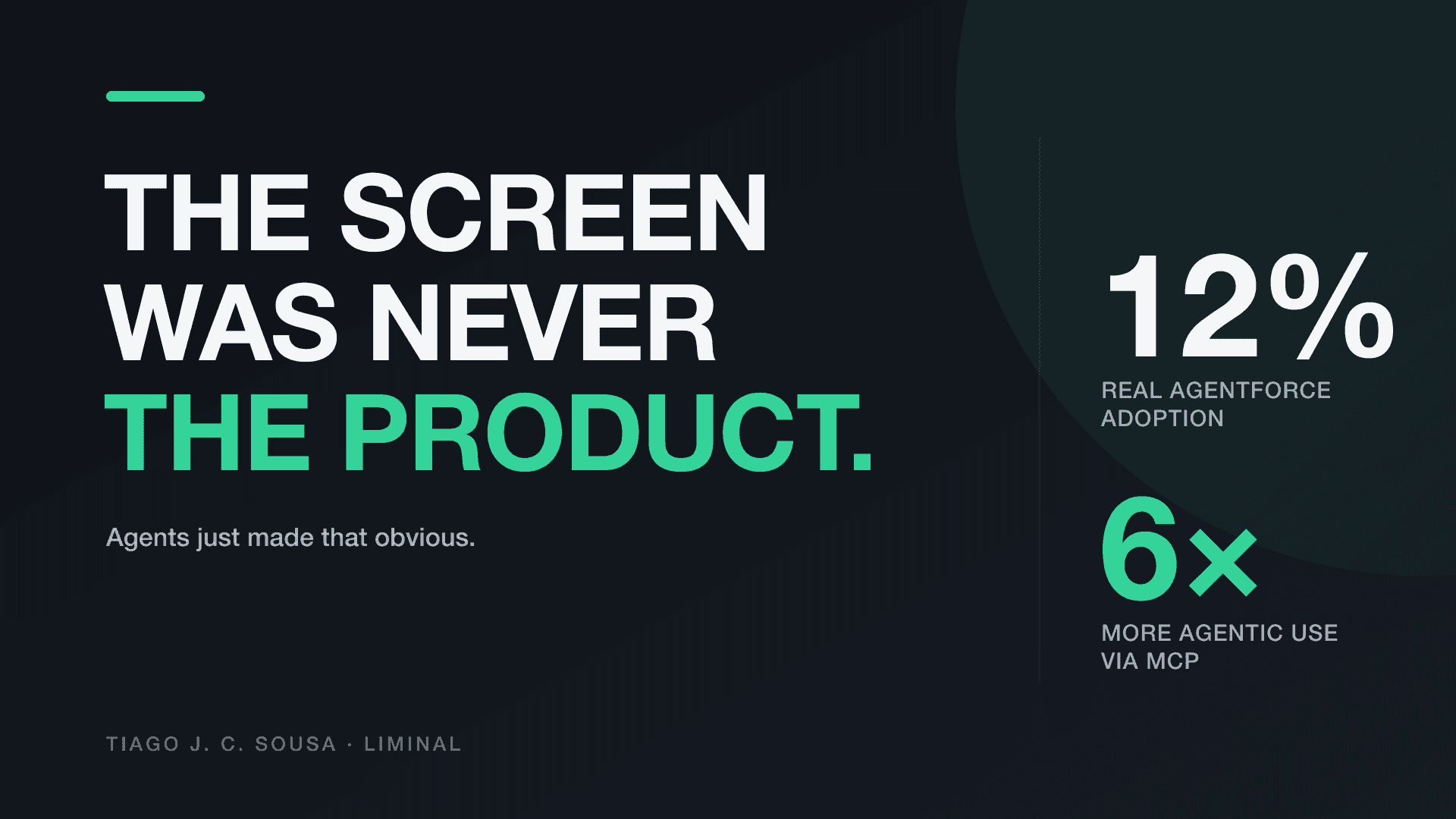
What Salesforce admitted on stage, what Anthropic just formalized, and why neither means what most of the LinkedIn commentary says it does.
In March 2026, at TrailblazerDX in San Francisco, Parker Harris took the stage. Salesforce's co-founder, responsible for decades of the platform's engineering, was there to announce Headless 360 in front of a room full of developers, admins, and partners who had built entire careers configuring, customizing, and teaching people to navigate Salesforce's screen. He didn't deliver a sales pitch. He asked a question: "Why should you ever log into Salesforce again?"
By accounts from people in the room, the audience sat in uncomfortable silence for a second before applauding. Minutes later, the demo showed Slack becoming a Model Context Protocol (MCP) client, capable of orchestrating thousands of applications without ever opening a Salesforce browser tab. Hours later, on X, analyst Aakash Gupta summed up the moment in a line that spread through the community: "That's a $41B revenue company telling its own customers their seats are optional."
Five months later, on August 26, 2026, Salesforce and Anthropic announced Claudeforce: a plugin with 37 prebuilt sales skills that lets sellers work with live Salesforce data straight from inside Claude, Claude running inside Agentforce as a reasoning engine, and Claude inside Slack. Three directions, one movement: pull the human user off Salesforce's screen and put them in conversation with an agent that calls Salesforce through APIs behind the scenes.
The most common reading, the one that has dominated LinkedIn since April, confuses the screen with the product. It spent twenty-five years selling the category on the quality of that screen, so now that Salesforce shows work can happen without ever opening it, the assumption is that the value went with it. In practice, that value just moved somewhere else.
The screen was never the product
For 25 years, CRM sold on the quality of its screen: how easy it was to drag a deal between pipeline stages, how polished the dashboard looked, how fast a rep learned the interface. From here on, that stops being a competitive advantage, because fewer and fewer users will ever look at that screen. The real product, the thing that was always underneath and never visible to whoever bought from the demo, is the data model, the permissions, the business semantics, and the governance logic an agent has to trust before it touches a customer record.
An analysis of Salesforce's Q2 FY27 published by Nikhs on Substack under the name "Complexity Inversion" captures the mechanism well: large language models make interfaces abundant and trivial to generate. What doesn't become abundant is enterprise state, knowing that a specific quote needs two approvers, that an employee isn't authorized for a given action, or which system records the final decision when three different applications all claim to be the source of truth. Twenty-five years of identity, permissions, governance, and deterministic execution don't replicate with a prompt.
12%
Of Salesforce's 150,000 customers have an Agentforce contract
6%
Are on paid plans
Pratyus Patnaik made the same point in a widely shared LinkedIn analysis of Headless 360: going headless makes agents the primary users, and that "pushes the SaaS moat down to data quality, semantics, and workflows rather than interface design." It's the same logic Salesforce itself uses to justify moving from per-seat pricing to per-API-consumption pricing: customers now pay for headless consumption, priced against their license edition, and contract Claude's inference separately with Anthropic.
The counterargument that can't be dismissed
Marc Benioff didn't leave the argument unanswered. On CNBC, the same day Claudeforce was announced, he called the "SaaSpocalypse" narrative, the idea that AI agents are about to cannibalize enterprise software licenses, "nonsense." He pointed to hard numbers: seats across Agentforce Sales, Agentforce Service, and Slack grew year over year, and agentic use through MCP and CLI calls increased sixfold. "These AI models need this level of intelligence, security, and controls for users," he said. "Salesforce is first and foremost in the data business."
This argument deserves to be taken seriously, if only because it ends up pointing at the same thing the headless CRM thesis does. Benioff isn't really defending Salesforce's screen, he's defending the data, the governance, the trust an agent needs before it acts, which is exactly what now matters most. Seat growth is the human side of the business, the work that still requires a person to decide. The sixfold growth in MCP usage is a different kind of signal: proof that the part actually accelerating runs underneath the screen.
6x
More agentic use via MCP and CLI calls at Salesforce, cited by Marc Benioff
14%
Jump in Salesforce's stock after the Claudeforce announcement and Q2 FY27 results
The risk the official narrative won't mention
There's a problem no press release will admit: speed may be making worse the exact thing it's supposed to fix. In a popular discussion on Salesforce's admin forum in August 2026, several people reported that the speed at which Claude proposes changes is piling up technical debt faster than teams can document or review it.
This doesn't invalidate the headless CRM thesis, it's the missing proof that the governance and semantics layer really is the bottleneck, not a marketing talking point. When an agent writes faster than a team can audit, what's missing is a control layer, not a better interface, and that's precisely the layer almost nobody sells as its own category today.
37
Prebuilt sales skills in the Claudeforce plugin, in pilot now, open beta expected September 2026
60+
MCP tools shipped with Headless 360 at TDX 2026
What changes for whoever configures CRM
If the value moves from the screen to the data model and governance, the most urgent question for a CRM, automation, and process optimization consultancy is this: what happens to a business built around configuring screens, flows, and forms?
That business is unlikely to disappear. It changes shape, and whoever's slow to reposition loses ground to whoever moves first. George Brown, CEO of implementation consultancy Top Dynamics Partners, describes exactly this shift in how Dynamics 365 implementation partners get chosen: for 25 years, the choice came down to certifications, project count, and industry references. With autonomous agents now executing multi-step processes independently, that's no longer enough. "Partners who can't design, deploy, and govern AI agents aren't just behind, they're a risk to your implementation," Brown says. The same criterion applies, without meaningful change, to choosing a Salesforce or HubSpot consultancy.
Three concrete bets follow from this:
- Designing the semantic model stops being invisible work. Mapping fields, objects, and relationships used to be the prep work before the real deliverable. Now it is the deliverable: an agent reading and writing to a CRM needs a clean, well-documented data model to avoid making mistakes.
- Agent governance is a new service. Deciding who can approve what, which actions an agent can take without supervision, and how a decision made by an agent rather than a person gets audited requires skills most consultancies don't have in-house yet.
- Manual configuration, at scale, is going to shrink. Repetitive configuration work is being automated regardless. The open question is whether a second revenue line is already in place by the time it happens.
What changes for whoever buys CRM
For enterprise decision-makers, the buying criterion that dominated the last decade stops making sense. If fewer and fewer people are going to spend their day navigating the screen, ease of use stops being a decision factor. What matters is whether the vendor's data and governance hold up when multiple agents read and write at the same time without losing consistency.
That has a practical implication for contract negotiation. Per-seat pricing was designed for a world where every person logged in every day. In a world where that login becomes optional, negotiating on license count alone stops protecting the buyer. The question to ask a vendor becomes: what does API consumption cost once agents, not people, become the primary users? And choosing an implementation partner now has to include, as an explicit criterion, the ability to design and govern agents, not just a track record of configuration work.
What changes for whoever builds CRM
The most instructive counter-case in this shift didn't come from Salesforce. It came from HubSpot. In April 2026, HubSpot took its MCP server to general availability, with a one-click Claude connector, months before Salesforce closed the Claudeforce deal. The incumbent that defined the "CRM with the best screen" category had to import intelligence through a partnership with an outside AI lab to reach a place the challenger had already gotten to on its own, because it had been API-first from the start.
For whoever leads product at a SaaS or CRM vendor, the lesson here is mostly about timing rather than about who wins the CRM war: being API-first from day one buys a real head start in a transition nobody gets to skip. Once the interface stops being a competitive advantage, the investment that pays off is the gap in data, semantics, and trust an outside agent has to cross to work with the product without the vendor losing control over what that agent can do.
The question that remains
For 25 years, CRM sold two things at once without anyone needing to tell them apart: the screen, and what sits beneath it. Headless CRM is the moment that separation became visible, and it became clear which of the two parts could be dropped without losing anything essential.
There's a more interesting question than whether agents replace CRM: who ends up owning the data model those agents have to trust blindly? Who designs the governance that decides what an agent is allowed to touch? And who keeps selling screen configuration to a market that no longer wants to open one? Salesforce spent 25 years betting on the best screen in the market. It's now betting the next chapter on not needing one at all.
Sources
- Salesforce & Anthropic. (2026). Salesforce and Anthropic Announce Claudeforce [Press release]. Salesforce.
- CNBC. (2026). Salesforce, Anthropic expand partnership as Benioff responds to 'SaaSpocalypse' concerns.
- CNBC. (2026). Salesforce CEO says 'SaaSpocalypse' is nonsense, AI will not erode SaaS.
- VentureBeat. (2026). Salesforce just put its entire CRM inside Claude, and says you'll never need its app again.
- Nikhs. (2026). Salesforce Q2 FY27: The Complexity Inversion [Post]. Substack.
- Diginomica. (2026). Why should you ever log into Salesforce again? It's a good question, says co-founder Parker Harris.
- Salesforce Ben. (2026). "Why Log Into Salesforce Ever Again?" Parker Harris Bets Future on Slackbot.
- Salesforce Ben. (2026). Are Salesforce Customers Actually Adopting Agentforce?
- Barchart / StreetInsider. (2026). Agentic AI Is About to Make Dynamics 365 Partner Selection Harder, Not Easier.
- HubSpot Developers. (2026). HubSpot MCP Server.
- Patnaik, P. (n.d.). Salesforce's Headless 360 is a big indicator [Post]. LinkedIn.
- Gupta, A. (2026). Salesforce co-founder Parker Harris just said the quiet part out loud [Post]. X.
- r/salesforce. (2026). Claude might be making Salesforce technical debt worse [Discussion].
The quotes from Marc Benioff, Pratyus Patnaik, and George Brown are translated into Portuguese in the PT version of this article from the sources above; this English version renders them as originally published, not verified word-for-word beyond the source.