27 July 2026 · 9 min read
The decisive AI in your next B2B deal isn't yours. It's your buyer's.
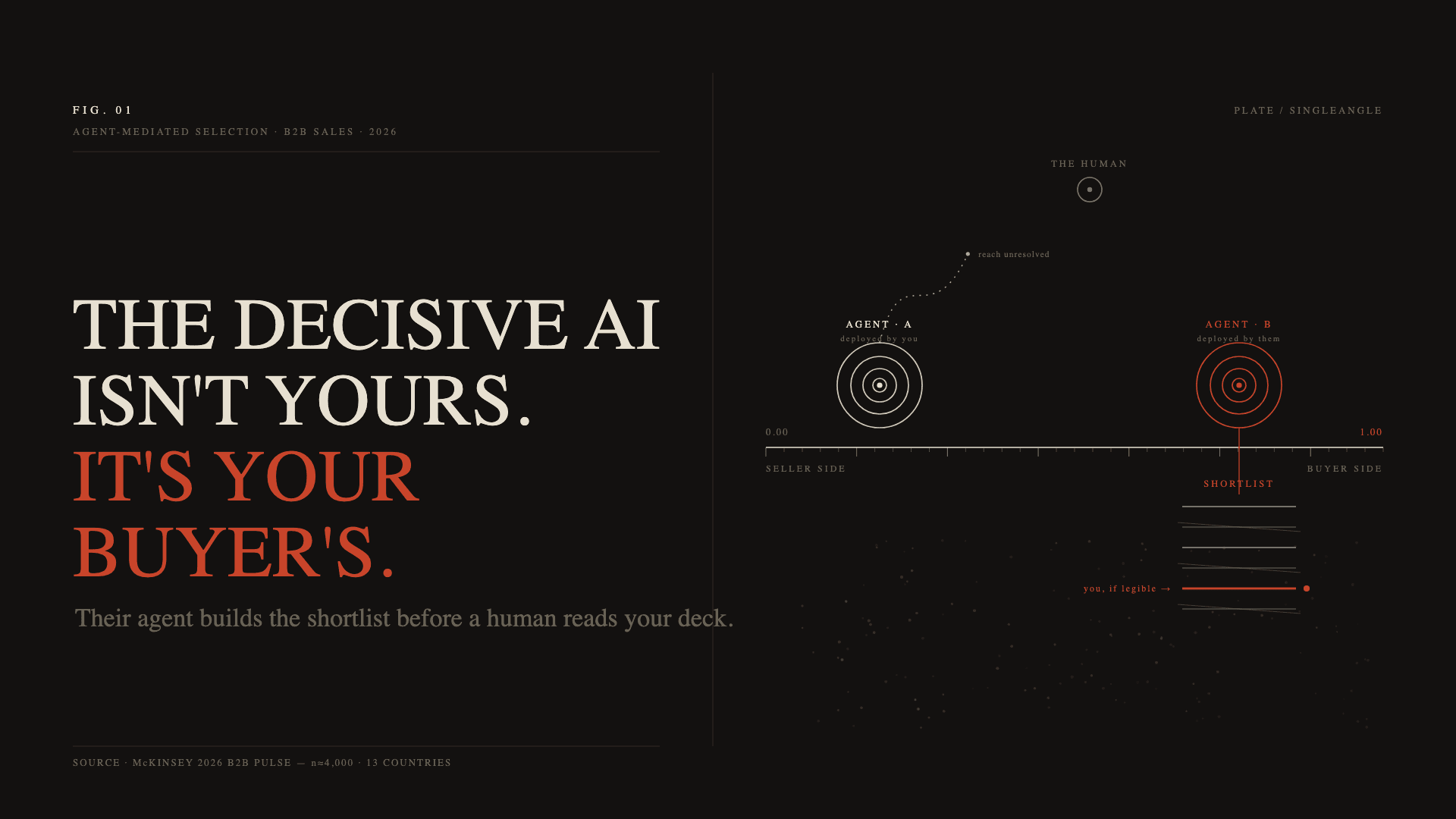
Everyone is arming the seller's side of the table. McKinsey's growth champions won by rewiring around the other side, the one you don't control. A field note for founders and GTM operators.
You're building an AI to talk to a human.
Your buyer is building an AI so they never have to.
Whoever's machine is smarter wins the deal. Right now, most founders are only training their own.
That sentence should bother you more than it does. The entire 2026 sales-tech cycle is selling you the opposite instinct, and the companies pulling ahead already stopped believing it.
The race everyone is running
Open any vendor deck this quarter and you'll see the same picture. An autonomous SDR that "owns outcomes." It researches the account, drafts the outreach, books the meeting, updates the CRM, and never asks for a raise. Bolt it on, cut headcount, watch pipeline climb.
It's a seductive story for a founder. Headcount is your most expensive line. An agent that works nights and weekends for a subscription fee looks like free money. So the reflex is to spend your AI budget making your own outreach faster, cheaper, more autonomous, all to win the race to talk first.
Here's the problem. The race to talk first assumes the buyer is still waiting to be talked to. Increasingly, they aren't.
What McKinsey actually found
McKinsey ran its 2026 B2B Pulse across nearly 4,000 buyers and sellers in 13 countries. The headline gap is brutal. High-growth companies were three times more likely to have raised AI investment by double digits year over year: 71% versus 25% of laggards. Sixty percent of leaders posted double-digit revenue growth last year. Only 21% of laggards did. Ninety percent of leaders reported improved sales effectiveness, against 55% of everyone else.
3×
More likely to have raised AI investment by double digits
60% vs 21%
Double-digit revenue growth: leaders vs. laggards
90% vs 55%
Reported improved sales effectiveness: leaders vs. everyone else
Easy misread: "the winners spent more on AI." They did. But so did almost everyone. Spending wasn't the variable.
The variable was what they did with it. Laggards bought tools and stapled them to the existing motion. Champions rewired the motion. They redesigned the commercial playbook around end-to-end outcomes and rebuilt the operating model so agents and humans work as one system, not as a human process with a bot bolted on the side.
McKinsey names five places champions rewire. Not five tools. Five journeys.
- Reach the right opportunities. Agents map the market, generate and prioritize leads, and surface the real decision-makers before a rep thinks to ask.
- With the right go-to-market model. Seller copilots and virtual account reps match coverage to account value instead of blasting everyone the same way.
- With the right offer and pitch. Smart account planning builds a customer 360 from outside-in intel, and meeting support captures everything.
- At the right price. Pricing agents give targeted discount guidance, deal scoring, and negotiation support, killing spreadsheet lag.
- Every single time. A virtual performance assistant and smart coach lift the median seller toward the top one, on every deal.
Look at that list as a founder and the trap becomes obvious. Every one of those journeys is still framed from your side of the table. Reach your opportunities. Improve your pitch. Close your deal. It's the correct advice, and it's only half the board.
While you rewire your side, the buyer is rewiring theirs.
The reframe: the buyer showed up with an agent too
The most under-priced fact in B2B right now is simple. Your buyer no longer arrives as a curious human with an open calendar. They arrive with an agent.
Brian McFadyen, a GTM operator, said it plainly: "We are no longer just selling to humans. We are selling to AI agents that scan whitepapers, compare pricing, and shortlist vendors before humans engage."
Sit with that. The shortlist, the single most decisive moment in any deal, is increasingly assembled by a machine. It happens before a human on the buying side has read a word of your material, and long before a human on your side gets a reply.
The signals are already measurable. 61% of B2B buyers now say they prefer a rep-free buying experience. This month, the top thread in a private community of B2B CMOs wasn't about outbound at all. It was "What should we do when AI agents visit our websites?" Buyers are engineering you out of the early conversation on purpose. And you are spending your AI budget trying to get into a conversation that is quietly being automated shut.
So the founder question changes shape. It stops being "how autonomous is my outbound?" It becomes: "when a machine builds the shortlist, does my company make it, and is there still a human sharp enough to win the round that's left?"
That's a category error most teams haven't noticed they're making. They're optimizing the seller's side of a table where the decisive reader has moved to the buyer's side, and turned into software.
Why "just replace the reps" is a false economy
Before we get to what you actually do, kill the tempting shortcut: replace the humans entirely and let the agents run.
The 2026 benchmark data is unkind to that plan. AI SDRs do win on the vanity metric, with roughly 50% higher email response rates than human-sent outreach. But responses aren't revenue. When you follow those responses down the funnel, AI-only setups convert meetings to deals at about 15%. Humans do it at 25%. Hybrid teams, with AI on research and first touch and humans on relationship and close, outclose both by 41%.
15%
AI-only: meetings converted to deals
25%
Humans: meetings converted to deals
41%
Hybrid teams outclose both by
That's why the market voted with its feet. Only about 22% of teams fully replaced their SDR function with autonomous agents. Around 45% went hybrid. The founders optimizing purely for cost-per-touch bought themselves a higher reply rate and a worse business.
There's a subtler finding buried in the case data, and it's the one worth tattooing on the wall.
The office where I watched it land
A Series-C SaaS company, roughly 300 people, did exactly what the vendors prescribe. Their SDRs were burning about 65% of the week on admin: CRM hygiene, account research, first-touch drafts, chasing calendars. So they handed all of it to AI agents.
Nine months later, the numbers looked like a slide from the tool's own website. Admin time down to 28%. Qualified pipeline up 24% quarter over quarter. Sales cycle 11 days shorter.
Then someone split the reps into two groups and compared them.
Here's the turn. The reps who edited the agent's drafts before sending, who argued with the machine, cut its filler, added the one detail it couldn't know, consistently beat the reps who just hit approve. Same agents. Same data. The only variable was whether a human still cared enough to change the output.
The AI didn't create the edge. It created the floor. It lifted everyone to competent, then handed the advantage to whoever refused to stay there.
That's the whole 2026 story compressed into one office. Autonomy is not the moat, because your competitor can buy the same autonomy on the same afternoon. The moat is the judgment the machine can't reproduce, and the discipline to keep a human applying it.
What a founder actually does about this
Two moves. Neither is what the vendor is selling you.
1. Make your company legible to the buyer's agent. If a shortlist is being built by a machine reading your public surface area, your job is to be the vendor that machine can parse, trust, and rank. Plain-language pricing logic. Concrete proof with numbers and named outcomes. Positioning stated in the buyer's terms, not your internal jargon. Structured answers to the questions buyers actually ask. If a human has to "just get on a call to understand it," you've already lost the round that happens before the call. Being discoverable by the buyer's agent is the new top of funnel, and most founders have optimized none of it, because no vendor makes money selling it to them.
2. Keep a human on the trigger, and make that the job. Deploy the agents. Let them eat the admin, the research, the first draft, the CRM sync. Then design the human role explicitly around what the Series-C data proved: reviewing, editing, and out-judging the machine. Don't hire people to send what the AI wrote. Hire and coach people to improve it. Build that expectation into the process, the enablement, and the comp, or your reps will quietly drift into rubber-stamping, and you'll wonder why the reply rate went up and the win rate went down.
Notice what both moves have in common. Neither is "buy more autonomy." Both assume the tools are commodities, because they are, and put your scarce effort where the deal is actually decided.
The uncomfortable close
McKinsey's champions didn't pull ahead by automating their side of the table. They rewired for the fact that the other side now has a machine too, and that outcomes, not tools, get rewarded.
Speed stopped being the constraint the day everyone got the same agents. When your outbound and your competitor's outbound are drafted by cousins of the same model, "faster" is table stakes, not an edge.
Two things still separate winners in 2026. Whether the buyer's machine can find you and put you on the list. And whether a human on your side is sharp enough, and trusted enough, to win the deal once the list is set.
Everything else is a subscription.
Sources
- McKinsey & Company, "The future of B2B sales: how growth champions rewire their playbooks with AI," and the 2026 B2B Pulse Survey (nearly 4,000 buyers and sellers across 13 countries), July 2026.
- Salesforce, State of Sales, 2026 (rep-free buying preference).
- 2026 AI-SDR benchmark data, industry aggregate (meeting-to-deal conversion and hybrid close rates).
- Brian McFadyen, GTM practitioner commentary.
- r/CMO_Huddles community discussion, July 2026.
Figures FIG. 01–02 are original visualizations; FIG. 02 redraws a McKinsey exhibit. Citations are text-only by design.