11 August 2026 · 5 min read
CRM adoption isn't a discipline problem. It's a design problem.
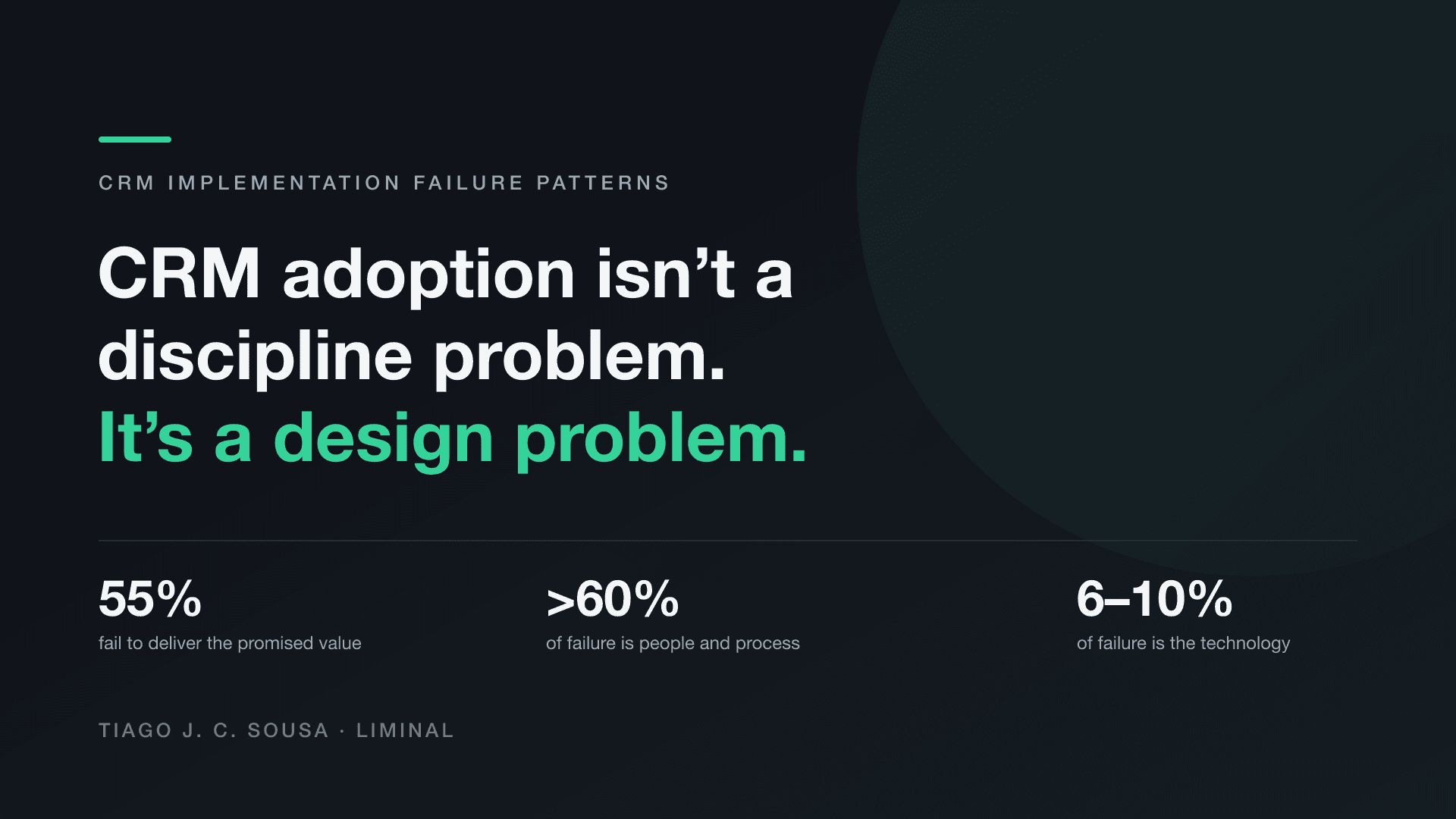
Only 6% to 10% of CRM failures come from technology. More than 60% come from people and process. Yet leadership's default response to a CRM that isn't delivering is to buy better software.
That number is worth sitting with. Studies have put CRM implementation failure rates between 30% and 70% for two decades. The most-cited 2025 figure is 55% of projects failing to deliver the promised value. Over that same period, the technology got better every single year. Platforms got faster, more integrated, smarter. And the failure rate hasn't moved.
When a problem survives two decades of technological improvement, technology isn't the variable.
The diagnostic error that costs the budget
The scene repeats itself in mid-sized B2B companies everywhere. Monday morning, pipeline review. The sales director opens their laptop and projects the forecast. It isn't the CRM dashboard the company paid six figures for last year. It's a spreadsheet, maintained by hand every Sunday night.
In the next room, the CRM adoption dashboard is green. Daily logins above target. The project was delivered "successfully": fields configured, workflows automated, training completed. Everyone logs in every day. And nobody trusts what's in there.
This has a name. It's called adoption theater. Login counts look healthy while data completeness quietly collapses, because people log in out of obligation and fill in the minimum to keep management off their back. The real work of selling happens somewhere else entirely: on the phone, in email, in their heads.
Leadership's reflex in the face of this is predictable. More training. More mandates. "From now on, everything goes in the CRM." Every turn of the screw just trains the team to log the bare minimum better, and pushes the pipeline they actually trust even further from the system.
Adoption is design, not discipline
Here's the reframe that changes the decision. CRM adoption isn't a willpower problem. It's a process design problem.
When the workflow lives around the system instead of inside it, working around the CRM is the rational behavior. The same team that "lacks discipline" for the CRM keeps an immaculate spreadsheet, because that spreadsheet gives something back at the moment they're actually selling. The CRM, as it was built, only gives reports back to people who aren't selling.
As Simon Leeming puts it, most failures happen because the system is built for administration while the sales team is expected to feed it. Or, in Brad Tornberg's framing: most implementations fail because we treat the work as a software problem instead of a business alignment problem.
The three dominant root causes confirm it:
43%
Poor adoption
34%
Poor data quality
22%
Insufficient training
None of these gets solved by switching platforms. All of them get solved before the platform is chosen.
What separates the projects that deliver
The good news is the data also points to the right lever.
3.5×
More likely to succeed with investment in change management
2.8×
More effective: phased rollouts vs. big-bang
And Forrester's three success factors:
82%
Executive buy-in
76%
User training
71%
Clean data migration
Notice that none of these factors is a software feature. They're all decisions about design, sequencing, and leadership behavior.
In practice, a project that delivers makes five decisions before go-live:
- Design the process before configuring the tool. Pipeline stages have to mirror how the team actually sells, not a textbook funnel. Configuring dozens of custom fields before anyone has sold a single deal is the most common recipe for resistance.
- Integrate where the work already happens. If logging a deal means leaving email, the calendar, or the sales tool, you've lost. The goal is for the path of least effort to run through the CRM.
- Define the right adoption KPIs. Logins measure nothing. What matters is the completeness of the fields that feed the forecast and the percentage of deals with real activity logged against them. Measure behavior, not presence.
- Treat data migration as a project, not a task. Dirty data going in guarantees distrust coming out. And unlike a spreadsheet, bad CRM data propagates into marketing automation, analytics, and customer support.
- Name an owner after launch. Most CRMs don't die at go-live. They decay in the months after, when nobody owns data standards, request review, or system health. Without governance, the CRM is just a very expensive spreadsheet.
The honest counter-argument
Some will say the failure isn't design, it's discipline: the CRM simply exposes an absence of process and accountability that already existed. That's half right. The CRM is, in fact, a mirror. But that's exactly the point. If the system exposes a process that doesn't exist, the answer isn't to demand more discipline over a nonexistent process. It's to design the process first, and only then install the system that serves it.
The project doesn't fail at go-live. It fails on the day someone decided to install a system instead of redesigning a workflow.
Your CRM doesn't need more training. It needs the work to run through it. As long as the spreadsheet is the source of truth, you're paying for two systems and trusting one.
Sources
- Atyantik. (2025). Why CRM projects fail in 2025 and how to fix it.
- Forrester Research. (2025). CRM implementation success factors [data cited in Faye Digital and Kindsight].
- Huble. (2025). Why CRM implementations fail (and what enterprise teams can do about it).
- Ingram, C. (2026). Post on CRM delivery models. LinkedIn.
- Johnny Grow. (2025). The CRM failure rate is 55% in 2025.
- Leeming, S. (2025). Post on CRM friction and adoption. LinkedIn.
- Tornberg, B. (2025). Post on CRM as a business alignment problem. LinkedIn.
- Vantage Point. (2025). Why 70% of CRM projects fail: The people-process-technology framework.