3 August 2026 · 6 min read
AI in banking: choose the consultancy that survives the second room
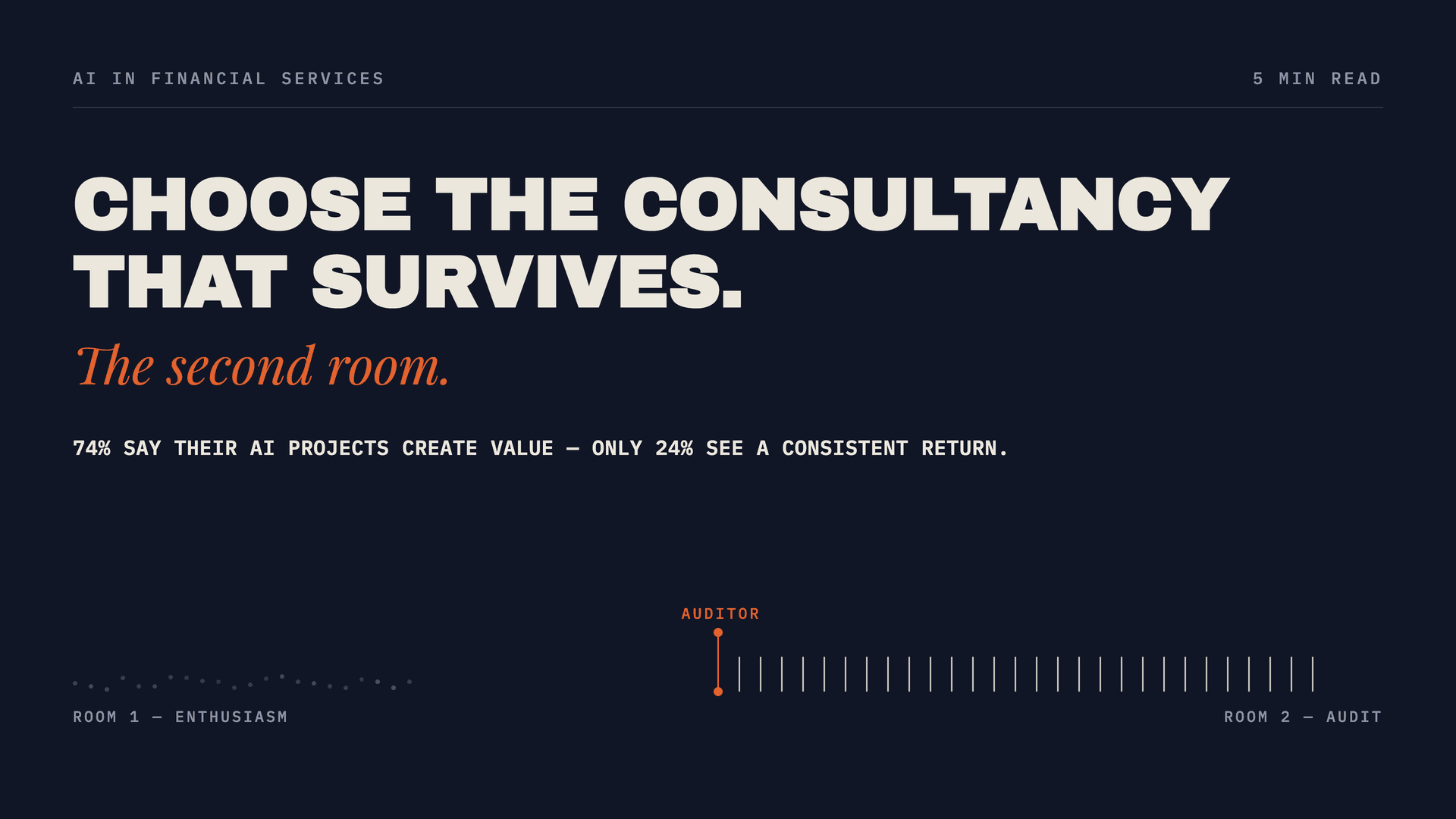
In financial services, the artificial intelligence project isn't decided in the boardroom. It's decided somewhere the consultancy rarely sets foot.
There are two rooms in the life of an AI project inside a bank.
In the first, the consultancy shines. There are slides, a vision, an ambitious roadmap, a use case that makes the board nod, and a pilot that runs flawlessly during the demo. It's the room of enthusiasm. And almost every AI consultancy was built, from its first hire to its last proposal template, to win it.
In the second room there's no applause. There's an auditor, a risk officer, and, sooner or later, a supervisor. They ask one question: "explain this decision to me." If the model can't answer, the project doesn't move forward. And it's here, far from the pitch deck, that it gets decided whether that AI creates value or turns into one more cost line with an elegant report stapled on top.
Most consultancies know how to win the first room. In financial services, they're hired to survive the second. Confusing the two is the most expensive mistake a financial leader can make right now.
Confusing the two rooms is the most expensive mistake a financial leader can make right now.
The second room, in Portugal, is no longer hypothetical
It's worth understanding how concrete this second room has become. Banco de Portugal is no longer just the body that scrutinizes other people's AI: it now operates its own platform, ALYA. The country has approved the National Artificial Intelligence Agenda 2026-2030, which brings the AI Act, regulatory sandboxes, and explicit governance and accountability requirements.
When the supervisor itself puts AI into production and writes the rules at the same time, something changes for whoever is buying. "Having an AI strategy" has stopped being a differentiator. It has become the entry ticket. And an entry ticket, by definition, is not what separates the winners from those left behind.
"Having an AI strategy" has stopped being a differentiator. It has become the entry ticket.
The entry ticket isn't enough
The Portuguese numbers are clear on this.
74%
Of executives say their AI projects create value
24%
Get a consistent return from them
In the financial sector, roughly three in four institutions already use AI and still can't govern it effectively.
Notice what these two figures say together. The problem isn't adoption. Portugal has adopted. The problem is the crossing: between the pilot that impresses and the system that holds up under production, audit, and scale, almost everything gets lost. The consultancy you choose determines which side of that ravine your investment lands on.
That's why the usual buying instinct sabotages the decision. Consultancies get evaluated on the question "what do they know about AI?", when the question that matters is different: "what have they already got running inside a bank, and is it still running today?" The first measures promise. The second measures consequence. Inside a financial institution, only the second one shows up in the P&L.
The first question measures promise. The second measures consequence. Only the second one shows up in the P&L.
What survives the second room
If the second room is the standard, three requirements change everything. Demand them before signing, not after.
Production references, not logos. Ask to see a model operating inside a real bank, with real users, for months. A portfolio of delivered strategies proves nothing about the ability to make them survive scrutiny.
Auditability by design. As Manuel Conde wrote about the sector, automation is only relevant if it's auditable. A model that can't explain itself to the supervisor isn't an asset. It's a risk waiting to surface. The right consultancy delivers the evidence trail and the accountability as a starting point, not as an extra it bills separately once the regulator comes knocking.
A model that can't explain itself to the supervisor isn't an asset. It's a risk waiting to surface.
One program, not a collection of pilots. KPMG is direct about the cause of the frustration: the problem isn't investment, it's fragmentation. Strategy, data, governance, and execution that don't talk to each other. Whoever sells only the strategy leaves the fragmentation intact, and leaves the client to solve it alone.
A signal worth reading
There's a quiet shift in the market that confirms where the scarce competence actually sits. When large banks need AI leadership, they've increasingly gone looking for it among people who came from fintech, not from the big tech firms. The reason is instructive. A fintech learns, from day one, to stand AI up inside the rules: identity, fraud, credit, supervision. It learns to operate in the second room before it even knows what the first one looks like.
What banks are buying, in those hires, isn't whoever dreams best about AI. It's whoever has already seen it survive scrutiny. Financial leaders would do well to choose their consultancies by the same standard they use to choose their own people.
What I tell the people who have to decide
I say this plainly to the financial leaders I work with. Technology isn't the risk factor in your AI project. The risk factor is choosing a partner fluent in the language of the first room who has never had to answer in the second.
Technology isn't the risk factor in your AI project. The risk factor is choosing a partner who has never had to answer in the second room.
Strategy still leads, and rightly so. But inside a supervised institution, a strategy is only worth what its execution in production is worth. And execution is only worth what it holds up to under audit. Hiring any other way is buying the easy part of a problem whose hard part is left entirely to you.
Before signing, run a simple exercise. Take the consultancy, mentally, into the second room. Put the auditor, the risk officer, the supervisor in front of them, and the question: "explain this decision to me." If the only answer you can picture is one more slide, the project's future is already written.
In the first room, intentions get sold. In the second, consequences get answered for. Choose your consultancy for the room you can't afford to fail in.
Sources
- Banco de Portugal. (2023). How AI helps us serve better: the ALYA platform [post]. LinkedIn.
- Conde, M. (n.d.). Agentforce 360 for financial services: a technical analysis [article]. LinkedIn Pulse.
- Human Resources Portugal. (2026). AI use in finance is growing, but governance models are lagging [post]. LinkedIn.
- KPMG Portugal. (2026). 74% of executives say AI projects create value, but only 24% get a consistent return [post]. LinkedIn.
- Vieira de Almeida & Associados. (2026). Portugal approves the National Artificial Intelligence Agenda 2026–2030 [post]. LinkedIn.
The KPMG and governance-study figures come from posts reporting the numbers; the primary source is the underlying report. The signal about fintech-origin AI hires is a qualitative market observation, not a verified statistic.