5 August 2026 · 4 min read
Knowing your workflow isn't keeping it
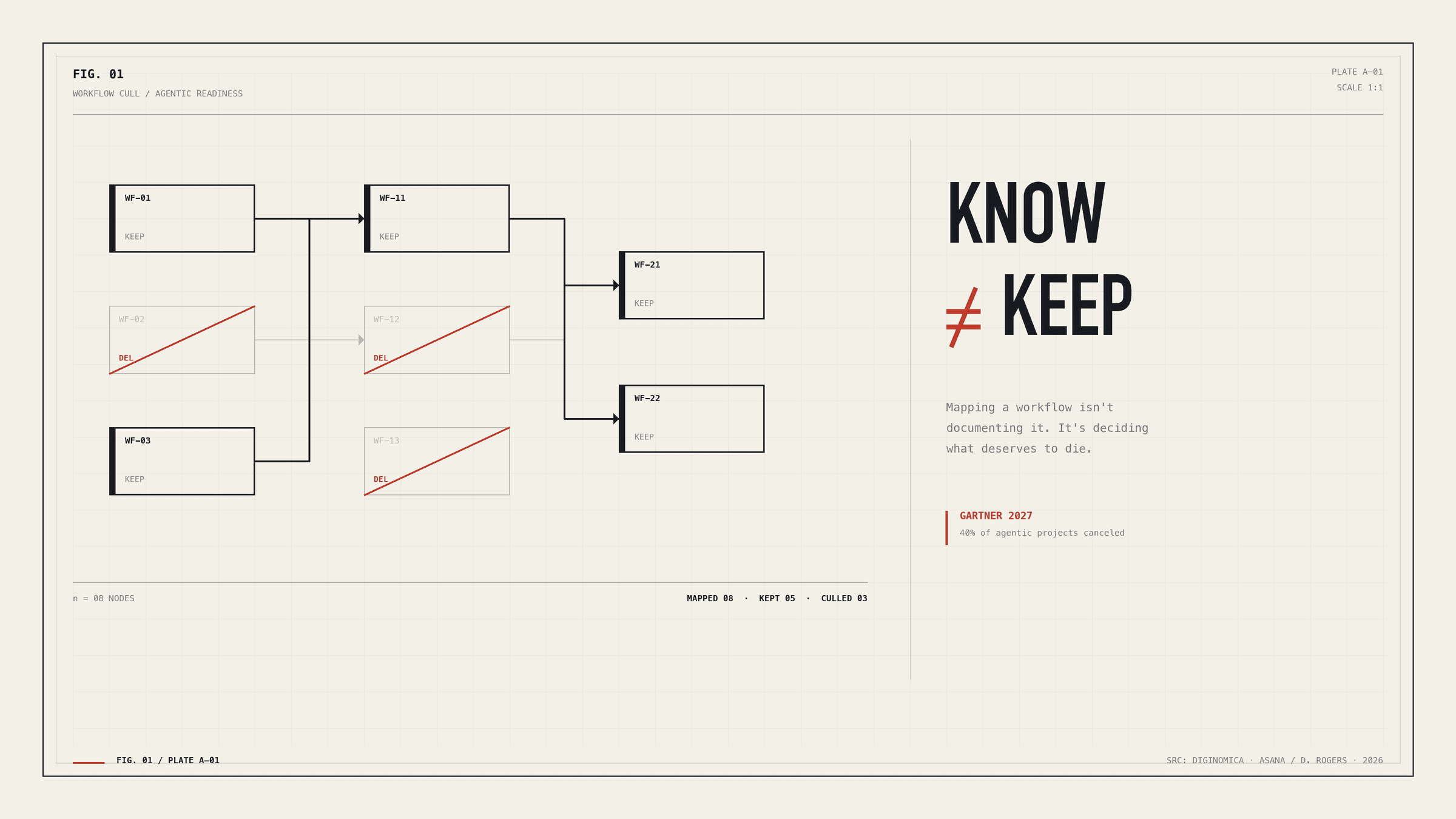
The advice of the moment is to map your workflow before handing it to an AI agent. What's missing is the part that decides whether that workflow should survive at all.
Asana's CEO says leaders can't even list their own workflows.
The real problem isn't that they don't know them. It's that they're going to automate them anyway.
Dan Rogers keeps hearing the same confession from executives everywhere. It isn't about models, cost, or talent. It's more basic, and more embarrassing: "I don't even have a list of my workflows." The process that keeps the company running lives in people's heads. It was never written down. It's impossible to hand to a machine.
The market's answer today is close to unanimous. Twenty-two LinkedIn posts and Asana's own CEO repeat the same line: "know your workflow before you agentify." It's good advice. Which is exactly why it became dangerous.
"Knowing the workflow" has quietly been translated into "preserving the workflow." Documenting the tribal process. Writing down the way things are done today. And most of those processes are broken.
Mapping a broken process doesn't fix it
Here's the discomfort the consensus avoids. Mapping and automating a broken process doesn't fix it. It scales the dysfunction at machine speed.
Mapping and automating a broken process doesn't fix it. It scales the dysfunction at machine speed.
Forbes Technology Council put it bluntly this year: making a broken process 30% more efficient doesn't change the competitive picture. It just makes the organization more comfortable doing the wrong thing faster.
The agentic layer is less forgiving of weak foundations than classic automation. An agent interprets goals and acts across systems. When handoffs are ambiguous and data is incomplete, the inefficiency doesn't stay contained. It propagates immediately. The agent amplifies whatever it finds. Find it a bad process, and it amplifies the breakdown.
The debt Gartner is measuring is process debt, not technical debt
No wonder Gartner predicts that more than 40% of agentic AI projects will be canceled by the end of 2027. The easy reading is technical debt. The correct reading is process debt, finally visible.
That's why, in May 2026, Asana acquired StackAI. Co-founder Toni Rosinol describes it as something that "brings workflows to the rest of us," making them visible in plain human language, no engineer required. Hundreds of integrations, from Gmail to HubSpot, promise to finally make the invisible visible.
And here's the turn almost everyone misses.
Making a workflow visible isn't the prize. It's the moment of diagnosis. When the process shows up on screen in human language, the useful question isn't "how do I automate this?" It's "why does this even exist this way?"
Map with a different question in mind
Most companies will look at the map and hit "agentify." The few that win will look at the same map and delete half the boxes.
Most companies will look at the map and hit "agentify." The few that win will look at the same map and delete half the boxes.
I know the objection. Mapping with discipline is the right first step: clear trigger conditions, defined handoff points, error handling, audit trails. I agree with the discipline. I disagree with the goal. The point isn't to map less. It's to map with a different question in mind: should this step even exist? Without that question, the audit just produces a well-paved cowpath.
And no, this doesn't require a big-bang redesign. Nobody stops the operation to reinvent everything. It starts with one well-defined workflow, measured, and pruned down to what survives the test. Pruning is incremental. Paving the cowpath is the thing that happens once, and expensively.
Human diagnosis becomes more valuable, not less
There's good news in this for the people doing the work. Human diagnosis becomes more valuable, not less. Asana itself admits it: its Forward Deployed Engineers remain essential for two to three years, helping clients figure out what to automate. The scarce work isn't building the agent. It's deciding which process should even exist.
Before asking which agent to install, ask which process should stop existing. That's the only discovery worth money.
Everyone is going to agentify the cowpath. Whoever wins will erase it first.
Sources
- Wainewright, P. (2026). Know your workflow before you agentify — Asana CEO Dan Rogers. Diginomica.
- Gartner. (2025). Gartner predicts over 40% of agentic AI projects will be canceled by end of 2027.
- Forbes Technology Council. (2026). Why enterprises that automate broken processes will only break faster. Forbes.
- SD Times. (2026). Stop paving the cowpath: Why agentic-first is the only way to build for the enterprise.
- MIT Technology Review. (2026). Enabling agent-first process redesign.